Artificial intelligence is a complex, evolving technology that intersects with many fields: computer science, ethics, economics, literacy and learning, and human psychology among them. On this page, we focus on some key AI issues for undergraduate students in a learning environment. (This page does not address all concerns about AI in all contexts.)
This section of the Library Research Toolkit is adapted from the excellent AI Literacy guide developed by librarian Jen Klaudinyi at Portland Community College Library. Portions of her guide have been rewritten or revised under Creative Commons Attribution-NonCommercial 4.0 International License. Visit Jen's guide for further details about her sources.
What is Generative AI?
Generative AI tools (like ChatGPT, Claude and Gemini) are technologies developed by companies using information harvested (or "trained") from the Internet, databases of public information, and other information sources using the tools that search engines use (such as page content, metadata, indexing, and cookies) to gather huge amounts of data as raw material. This raw material is the basis for outputs made by the predictive language of AI algorithms.
The Large Language Models (LLMs) used in generative AI are designed to predict patterns, not the reality of lived experience or holistic knowledge. When the data used in a predictive model is accurate, the AI output will be more accurate. When the data used in a predictive model is flawed, the AI output will be flawed as well. Outputs are influenced by which tool you use, and the prompts used in the query.
Generative AI isn't thinking, it is predicting.
Generative AI isn't creating, it is harvesting from existing information sources, including sources that are biased, incorrect, created by AI itself, and just plain fake.
Even so, the sheer volume of data, the immediacy and sophistication of the AI tool's response, and the tone of authority all suggest that AI outputs are truthful, authoritative, and correct.
Companies that create AI tools do not openly share the sources of their data. This raises many questions about what information is harvested by AI, and the potential uses (or violations) of personal data and intellectual property in massive data capture.
But AI is not one thing, nor is it one unified system. There are many products and applications in an actively expanding technology landscape. Unfortunately, many of the products available to the consumer (like us) are from very few companies: all are profit-driven and none are constrained by ethical guardrails or regulatory oversight.
Questions to Ask Yourself
LCC students are responsible for understanding what is acceptable AI use in each course and in every assignment.
Does your course syllabus include an AI policy or best practice?
If yes, read the policy carefully and understand the guidelines.
If no, be sure to talk with the instructor and ask specifically about how AI can or cannot be used in course assignments. If you do use AI tools, you must cite any tools or sources that you used. (See more on the Cite Sources page.)
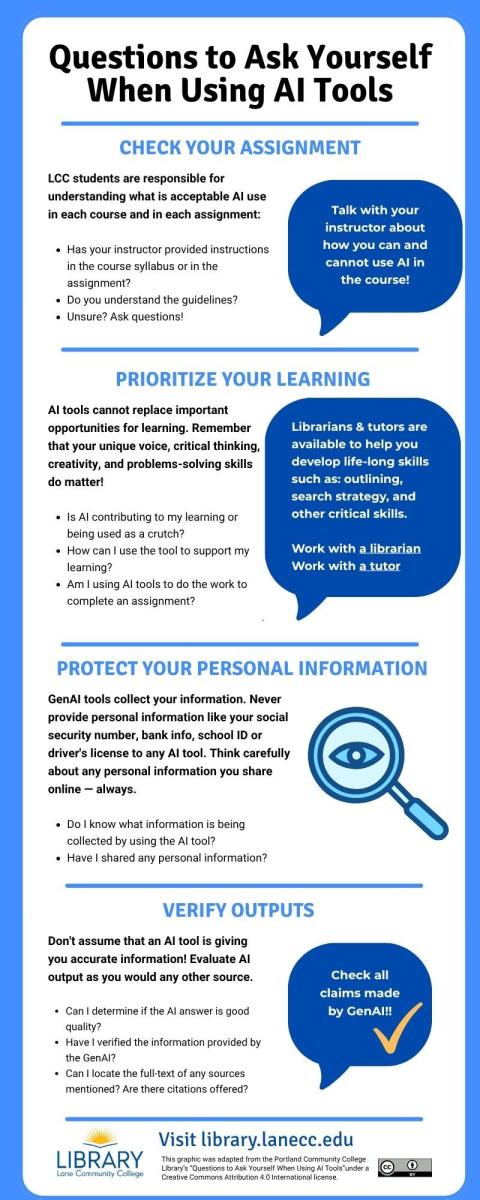
Course assignments are intended for learning. Review the infographic below for other important considerations about using AI.
Click on image below for the complete infographic or view the accessible version.
Creating Prompts & Verifying Outputs
Using AI tools effectively requires that you know the right questions to ask, and how to phrase them for the best results. Vague or generic questions generate vague or generic results. (In other words: garbage in, garbage out.)
To get better results from AI tools, include these components in your prompt:
Who am I?
What's the context?
What's my goal?
What do I want the AI to do?
Example:
I am a community college student writing a research paper for a writing course. We have been discussing topics related to social justice. I want my paper to relate to issues that affect the lives of community college students and that I can find information that will help me to persuade other students. Please brainstorm 3 research paper topic ideas. Limit your descriptions of each of them to a paragraph. Make sure that each description is unique from the other so that I have some diverse ideas to consider.
This prompt model and example above are based on the work of Dominic Slauson. For more guidance on writing effective prompts, visit AI Prompts Using the 5S Model.
Taking time to verify AI outputs or results is critical! Never assume that just because the information sounds authoritative, that it is. Information provided by AI should always be verified.
Take steps to verify claims made by AI:
When AI provides sources or citations, verify that they actually exist. Make sure you can find the sources and citations outside of the AI tool you’re using.
Copy the citation into a search tool like Google Scholar (make sure it is linked to the Library's database collections!). Search for the lead author and the publication.
If a source or citation is real, make sure it says what the AI response says it does. Read the source or its abstract.
If a source or citation is real, check for bias and reliability as you would for any source. Visit the Research Toolkit Evaluate Sources for step-by-step guidance for evaluating information.
Verify claims with additional sources. This could be as simple as searching for a Wikipedia entry on the topic or doing a Google search to see if a person/event/position actually exists.

Want to learn more about the universe of AI tools? Visit the LCC Fusion Lab to practice using AI technology products, or join the LCC Lex-AI Student Club to meet peers.
Ethical Questions about AI
Several aspects of the AI industry are cause for serious concern. Before you dive in, take some time to reflect on how AI is impacting education, the environment, the economy, and also existential questions about the preservation of humanity itself.
In an article, AI Ethics with Real Life Examples, computer engineer Cem Dilmigani, lists 4 essential concerns about AI:
Algorithmic bias - algorithms are trained on biased data from historical sources or due to bias built into systems, further "reproducing or amplifying social biases." AI is also known for hallucinations, or generating false, fabricated or nonsensical information that reads as convincing or authoritative.
Autonomous things - the dangers of self-managing technologies such as self-driving cars causing accidents, or chatbot therapists offering dangerous advice. Using lethal weapons or autonomous drones in warfare requires minimal human intervention with mortal, devastating effects.
Unemployment and income inequality due to automation - job displacement is predicted to be extremely high as a result of employer downsizing and automation. With fewer jobs available, we are already seeing high unemployment and long-term under-employment.
Misuses of AI - the misuses of AI are many and growing, and include:
- surveillance of citizens (overt/deliberate and covert/passive) and surveillance of speech
- wrongful identification in criminal cases
- information harvesting for profit, and privacy breach
- misinformation, disinformation and deepfakes in news media and political campaigns
Environmental Impacts - significant environmental impacts to the wide-spread use of AI, as data centers require vast amounts of energy and water consumption, pollute groundwater, and increase the carbon footprint. According to this Pew Research Center report, AI's impacts to the environment are both large scale and profit-driven.
And finally, AI itself presents existential concerns. Extreme automation, economic centralization and destabilization, and environmental degradation will impact people, climate, and societies' capacity to make decisions in the best interest of humankind.
Citing Generative AI
Attempting to cite sources that do not exist is a fool's errand. Before you try to cite, verify that external sources are real and not fabrications. For help with article, book, ebook, and other citation formats, visit the Research Toolkit Cite Sources.
Learn more about citing GenAI outputs in APA format.
Learn more about citing GenAI outputs in MLA format.